Placement of High Upper Eyelid Platinum Weight
Transcript
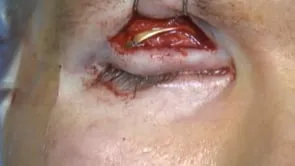
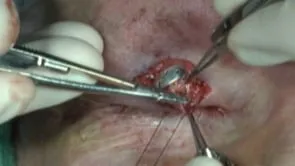
This is Richard Allen at oculosurg.com. This video demonstrates an upper eyelid load in a patient with a facial nerve palsy. This is a pediatric patient. The weight will be placed in a “high” or “supratarsal” position. Placement of a weight in this position has a number of advantages over a “pretarsal” or “low” position, which will be discussed. A 15 blade is used to make an incision along the eyelid crease marking. Dissection is then carried out through the orbicularis muscle to the underlying orbital septum. The orbital septum is opened and the preaponeurotic fat is dissected from the underlying levator aponeurosis. Thermal cautery is then used to disinsert the levator aponeurosis from the anterior surface of the tarsus. This will aid in decreasing retraction. Dissection is then carried out between the levator aponeurosis and the underlying Muller muscle. A 1.2 gram platinum weight is then placed between the levator aponeurosis and the Muller muscle. The weight is placed so that its inferior border is at the superior border of the tarsus. This will not induce as much astigmatism as a pretarsal position. The weight is sutured to the superior border of the tarsus with 6-0 Prolene suture. No suture is placed through the superior hole of the weight. I almost exclusively use a 1.2 gram weight, and I prefer platinum, as allergy to gold can be as high as 5%. The aponeurosis is then draped over the weight. This places additional tissue layers over the weight to decrease the possibility of extrusion or exposure compared to a pretarsal weight. The inferior edge of the aponeurosis is then sutured to then pretarsal edge of the orbicularis muscle. This again aids in decreasing eyelid retraction and helps form a lid crease. This is sutured with interrupted 7-0 Vicryl suture. The high position of the weight also is less visible than an inferior weight. The lid crease incision is then closed, in this case, with 5-0 fast absorbing suture. In an adult, a 6-0 Prolene suture would be used for skin closure.