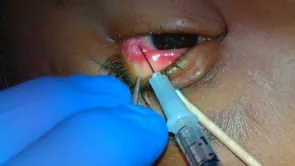
Facial Cosmetic Applications of Botulinum Toxin
Transcript
Facial Cosmetic Applications of Botulinum Toxin, authored by Craig Czyz, Jill Foster, and John Burns.
This video serves to introduce injection techniques for botulinum toxin. An apprenticeship with an experienced mentor is suggested as you begin your experience. In three decades of purposeful human use, botulinum toxin has gone from a deadly, feared neurotoxin to the most commonly used agent in minimally invasive cosmetic surgery. This video demonstrates locations and techniques for its use on the face.
Suggested materials for facial injection include botulinum toxin, saline, gloves, a marking device, skin antiseptic, and needles and syringes. The bottle of botulinum toxin is reconstituted with saline. The amount of saline added to the 100 units in the bottle determines the concentration of the facial solution. During treatment, the physician notes how many units of botulinum toxin are injected at each site.
Watching the natural movements and facial expressions of the patient assists in assessing dynamic areas of wrinkling. Purposeful movement of the area to be treated allows the physician to determine areas of muscle activity. The physician requests a scowl to assess the glabellar furrow, a surprised expression to activate the horizontal furrow, a squint to look at the crow's feet, and a grimace to delineate the depressor labii and pull down the corners of the mouth.
Marking shows how treatment will be aimed at decreasing corrugator and procerus function to diminish the glabellar furrows, weakening the frontalis to flatten the horizontal forehead lines, treating the orbicularis to keep the eyebrows elevated, and relaxing the depressor anguli oris and platysma to bring up the corners of the mouth.
Injection locations are prepped with Betadine solution. While injecting the corrugators, the nondominant hand is used to compress the tissue along the orbital rim and pinch the tissue at the injection site. Five to 10 units of botulinum toxin are injected into each site in the glabella. The total dose for the glabella would typically be 20 to 30 units in the female and more in the male. In this patient, asymmetric furrows are addressed by adding an additional injection on the right side.
The horizontal forehead lines are treated with injections of 2.5 to 5 units per site. While diminishing the wrinkle lines is desired, complete paralysis of the frontalis is not. This would result in a drop in the position of the brow. The total dose for the female forehead is 7.5 to 15 units.
To elevate the brow or decrease the crow's-feet lines, injections are placed in the orbicularis oculi along the lateral orbital rim. Treatment at and above horizontal is traditional. Treatment below the lateral canthus will soften the wrinkles in the lower eyelid, but runs the risk of increasing lower eyelid edema and steatoblepharon from decreased tone of the orbicularis.
The depressor anguli oris is treated to bring up the corners of the mouth. Care is taken to stay lateral to the lateral orbital commissure to prevent inadvertent treatment of the depressor labii in the lower lip. Unplanned depressor labii weakness would result in rolling in of the lower lip towards the teeth.