Reformation of the Lateral Canthal Angle
Transcript
Happy new year! This video demonstrates reformation of the lateral canthal angle. Often, when a lateral tarsal strip is performed, the lateral upper eyelid will override the lateral lower eyelid. Although this may resolve with time, it can persist and sometime causes discomfort in the early postoperative period. By reassociating the lateral upper and lower eyelid, the angle is reformed and reinforced. I use this technique quite often, especially in the repair of lower eyelid ectropion and retraction.
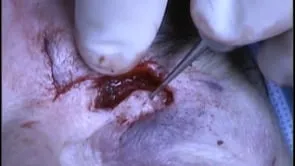
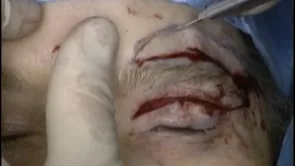
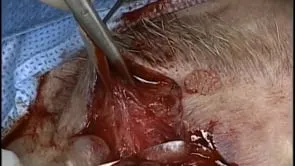
This is Richard Allen at oculosurg.com. This video demonstrates a technique to reform the lateral canthal angle. In the current video, the patient was undergoing reconstruction after skin cancer resection. The lateral defect helps demonstrate the technique and its effectiveness. A lateral tarsal strip is initially attempted. As demonstrated in previous videos, the strip is engaged with a double armed 4-0 Mersilene suture on an S-2 needle. Each needle then engages the periosteum of the lateral orbital rim in a relatively posterior and superior position. Tightening the suture shows good repositioning of the lateral lower eyelid; however, the lateral upper eyelid has a tendency to override the lateral lower lid with an indistinct lateral canthal angle. The solution for this is to resect the lateral 3 mm of the posterior lamella of the upper lid. This area is then engaged with a 5-0 Vicryl suture, which then engages the lateral edge of the lateral tarsal strip. Tying the suture reassociates the eyelids at the lateral canthal angle. Tying the lateral tarsal strip then reinforces the lateral canthal angle. I use this procedure in most of my lateral reconstructions including lower eyelid ectropion and retraction repair. The Mohs defect was then repaired with a Mustarde flap.