Full Thickness Skin Graft
Transcript
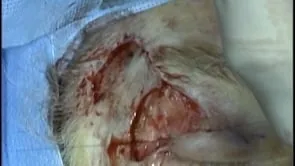
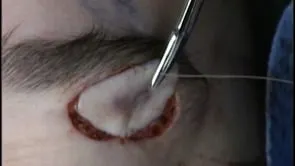
This is Richard Allen at the University of lowa. This video demonstrates full thickness skin grafting. The patient is status post moss excision of a basal cell carcinoma from the left lower lid. It has been determined that adequate skin is available on the ipsilateral upper lid to cover the defect of the lower lid. A blepharoplasty has been marked to ensure that adequate skin remains foreclosure postoperatively. A monopolar cautery is used to excise the skin. A blade and scissors could be used if desired. For S zero silk is placed at the level of the meibomian glands. These sutures will be used as a frost suture later. I will usually tighten the lid in these cases in order to add to postoperative stability of the lid.
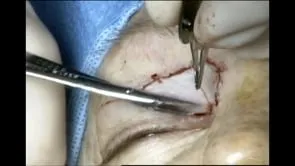
This will be performed with your STA standard lateral tarsal strip. Canmy canthal lysis dissection between the anterior and posterior Laila, excision of the mucocutaneous junction, scraping of the tarsal conjunctiva, shortening of the strip, and suturing the strip to the lateral orbital rim at the level of OL's tubercle. The suture used here is a four S zero meline suture on an S two needle. These sutures are placed relatively superior and posterior after placement of the sutures. They are tied. The skin graft is then placed into the lower lid defect. Prior to doing this, any remaining orbicularis is excised from the back of the graft so that only dermis and epidermis remain. Usually I would make a template of the defect prior to harvesting the skin graft. In this case, the maxımum amount of skin was removed from the upper lid, so the graft is trimmed to fit the defect. The graft is then sutured into position. Seven dash zero Vicryl suture is used in this case. I will also use a five dash zero fast absorbing gut suture or a permanent monofilament suture such as a six dash zero proline or nylon.
Suture. Interrupted sutures are placed in four cardinal positions followed by a running suture to complete the closure. After completing the closure, the upper eyelid incision is also closed and this case, this will be performed with a six dash zero proline suture. This can be placed in an interrupted or running fashion, as is noted in this case. Silk sutures are then used to fixate the subsequent bolster into position. Depending on the size of your graft, anywhere from two to four sutures may be needed. Two are used in this case. Some surgeons will place these sutures to incorporate the edge of the graft. In this case, sutures are placed outside the graft After placement of these sutures, antibiotic ointment is placed on the surface of the graft. This is followed by placement of a bolster, which has underlying telfa and a sponge. I like to use a sponge from a sterile scrub sponge without soap.
The sutures are then tied to place adequate pressure on the graft. The graft should remain undisturbed for one week so that it establishes its vascular supply. The frost sutures are then taped to the patient's forehead to keep the eyelid on stretch. This is then followed by placement of a double iPad. The patient returns in one week for removal of the iPad and bolster.