O to Y Flap
Transcript
Greetings from Philadelphia. I have no disclosures today.
We know that canthal reconstruction can be challenging and complex due to the concave nature of the medial canthal area, the eyelid fissures getting in the way of tissue rotation and advancement, the underlying anatomy of the canthal tendons and lacrimal sac medially, and, finally, the relaxed skin tension lines, which are often crossed perpendicularly and violated when we do our reconstructive techniques.
We see with a full-thickness skin graft here a nice closure, but a skin mismatch and a circular scar. We see with a rhomboid flap or a bilobed flap a nice closure, but a scar where we violated the relaxed skin tension lines.
As a result, I have developed a novel O-to-Y flap that is a double advancement flap, placed either medially or laterally, and converts a round, circular defect into a Y-shaped scar following the natural relaxed skin tension lines. The key, like any procedure, is to undermine the tissue appropriately, advance it without tension, trim it to fit the defect, and then secure it deeply with anchoring stitches to the periosteum or canthal tendon, or both.
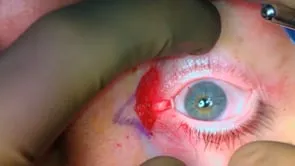
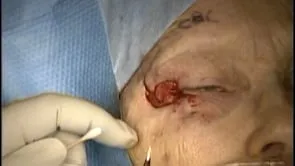
Here you can see two wounds and the proposed incision lines. Here you see the proposed dissection. Here is a case before surgery and intraoperatively with the flaps raised.
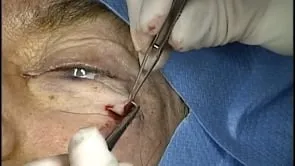
Here we see a video with the technique being demonstrated. We see scissors being used to dissect in the subcutaneous plane, to elevate superiorly up towards the brow, and to mobilize the tissue appropriately. Once this is advanced superiorly, the same technique will be done inferiorly. Once the tissue is placed into position—sorry for the choppy video here—but once the tissue is advanced, it can be trimmed and closed, as we see here in these two examples.
This technique with the O-to-Y flap is shown here before and after, with a nice result. A second case is shown preoperatively, intraoperatively, and postoperatively, with a well-closed wound and minimal scarring. A third case has a nice closure. A fourth case of the O-to-Y flap has a beautiful result.
Obviously, in the early part of the series, where I have done about 25 of these cases so far, this case did end with a little mild medial canthal banding if you do not appropriately advance and trim your flaps. But, in general, the O-to-Y flap is a viable option for small to medium-sized canthal defects.
With that, I say thank you.