O to Y Flap
Transcript
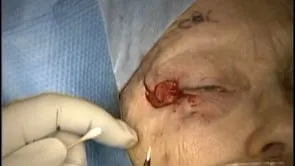
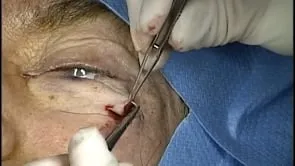
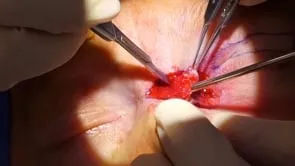
Greetings from Philadelphia. I have no disclosures today. We know that canal reconstruction can be challenging and complex due to the concave nature of the medial canal area. The eyelid fis are getting in the way of tissue rotation and advancement, as well as the underlying anatomy of the canal, tendons, the lactose sac medially. And finally, the relaxed skin tension lines, which are often crossed perpendicularly and violated. When we do our reconstructive techniques, we see with a full thickness skin graft here, a nice closure, but a skin mismatched in a circular scar we see with a ro blue flap or a bi lobe flap. Nice closure, but scar where we violated the black skin tension lines. As a result, I've developed a novel O to Y flap that is a novel double advancement flap, placed either medially or laterally and converts a round circular defect into a y shaped scar following the natural relaxed skin tension lines. The key, like any procedure, is to undermine the tissue appropriately, advance it without tension, trim it to fit the defect, and then secure it deeply with anchoring stitches to the periosteum or canal tendon or both. Here you can see two wounds in the proposed incision lines. Here you see the proposed dissection. Here is a case, uh, before surgery and intraoperatively with the flaps raised. Here we see a video with the technique being demonstrated. We see surgery, uh, scissors being used to dissect in the subcutaneous plane to elevate superiorly up towards the brow and mobilize the tissue appropriately. Once this is advanced superiorly, the same technique will be done inferiorly once the tissue is placed into position. Sorry for the choppy video here. Uh, but once the tissue is advanced, it can be trimmed and closed as we see here in this two examples. So this technique with the O to Y flap shown here before and after with a nice result, A second case preoperatively, intraoperatively, and postoperatively with a well closed wound and minimal scarring. A third case with a nice closure, a fourth case of the O to Y flap with a beautiful result. Uh, obviously in the early part of the series, uh, where I did about 25 of these cases so far, uh, this case did end with little mild media can banding if you don't appropriately advance and trim your flaps. But in general, the O to Y flap is a viable option for small to medium sized can defects. And with that, I say thank you.